2026-05-22
Disclaimer: This article is not investment advice and is not a recommendation to buy or sell securities. I am not a licensed financial advisor. The information presented here is based on publicly available sources and my own research. Stock and ETF investments carry price risk up to and including total loss. Always make your investment decisions yourself and consult a qualified professional if needed. All information without guarantee.
How I got onto this topic
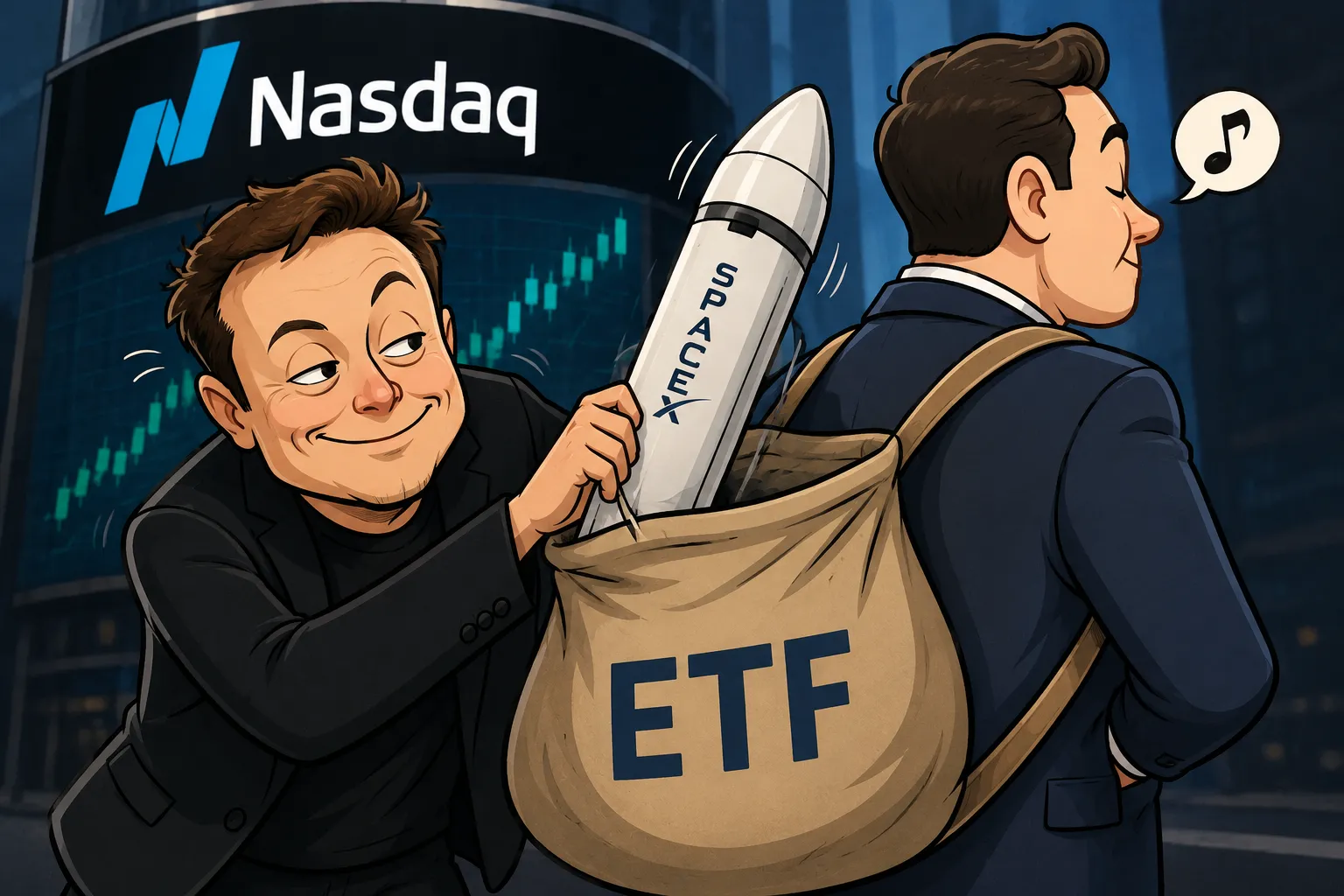
Over the past few weeks, I kept running into YouTube videos and forum posts that sharply criticized the Nasdaq. The accusation: the index provider had deliberately rewritten its rules so that SpaceX could be added to the Nasdaq 100 as quickly as possible after its planned IPO on 12 June 2026. The mood in the comments ranged from legitimate criticism of a questionable move all the way to outright outrage over the favoritism shown to a single company.
This caught my interest, because for quite a while now I have been making regular contributions to the Vanguard FTSE All-World UCITS ETF (Dist.) with the ISIN identifier WKN A1JX52, affectionately called "the holy grail" in some saver communities. The question nagging at me: does this whole circus actually concern me too? Am I sitting comfortably on the sidelines with my broadly diversified world ETF, or am I going to get SpaceX flushed into my portfolio through the back door anyway?
So I researched it properly. Here is what I found out.
What the Nasdaq actually changed
First, the facts. Effective 1 May 2026, the Nasdaq adjusted its index rules in several respects, and all of the changes affect the Nasdaq 100, the index tracked by the well-known Invesco QQQ ETF, among others. The official methodology documentation can be found directly at Nasdaq Global Indexes (2026 May NDX Changes FAQ).
First: there is a new "Fast Entry" rule. New issues that rank among the top 40 by market capitalization can now be added to the Nasdaq 100 after just 15 trading days. Previously, a minimum of three to twelve months was customary.
Second: the previous minimum requirement of 10% freely tradable shares (free float) was dropped. Without this loosening, SpaceX, which according to industry reports will go public with a free float of around 5% (CNBC), would not have been eligible at all.
Third, and this is the real flashpoint: instead of a hard minimum free float, a modified weighting rule now applies. Securities with a free float below 33⅓% receive their weight according to the following formula: market capitalization times free-float percentage times three (capped at 100%). So a company that enters the index with a 10% free float is weighted at 30% of its market capitalization instead of the mere 10% that is actually tradable.
At a SpaceX valuation in the range of 1.75 to 2 trillion USD and a free float of around 5% (roughly 90 to 100 billion USD of freely tradable shares), the stock would therefore receive an index weight equal to three times that, around 270 to 300 billion USD. The effect: passive ETFs tracking the Nasdaq 100, with assets of around 600 billion dollars (etfstream.com), would have to buy SpaceX shares in a quantity far exceeding the actually available free float. That drives up the price and disadvantages index investors, who are forced to acquire these shares at artificially inflated prices.
So much for the Nasdaq. But: my ETF does not track the Nasdaq 100.
The risk that was actually keeping me up
To make clear what this was really about for me: my concern was not the rule change as an abstract annoyance, but a very concrete chain of events at the end of which my portfolio takes the hit.
It begins with an index weighting a stock higher than its freely tradable share warrants. All passive funds tracking that index then have to buy the security in exactly this inflated quantity. They have no choice, because dumb replication is the entire principle of passive investing. When these mandatory purchases meet a tight free float of only 5%, the price gets pushed up. So the funds buy in expensive, not because the company is so great, but because the index mechanics force them to.
The unpleasant second part comes later. After an IPO, lock-up periods usually apply to existing shareholders and employees. When they expire, a lot more stock suddenly hits the market. If the price then falls back from its artificially elevated level, the index funds are left holding a position they had to build up at a high cost and that is now losing value. In the end I bear that loss, together with everyone else dutifully contributing to the index.
That was exactly my nightmare scenario: SpaceX wildly overrepresented in the index, then a sell-off after the lock-up that drags the entire index down and takes my savings-plan returns with it. So the decisive question is not just "will SpaceX enter my index," but "at what weight, and how hard would a SpaceX crash hit my ETF."
What applies to my ETF
The A1JX52 tracks the FTSE All-World Index, which is calculated by FTSE Russell (a subsidiary of the London Stock Exchange Group). This means completely different rules apply to my ETF, namely the "Ground Rules" of the FTSE Global Equity Index Series.
I obtained the current rulebook (Version 14.0, January 2026) directly from FTSE Russell and read it (FTSE Russell Ground Rules PDF). The points relevant to me are in sections 6.2 and 8.1.
Fast entry after IPO: a new stock can be added to the FTSE index after five trading days if it exceeds certain market-capitalization thresholds (Rule 8.1.3). That is in fact even faster than the Nasdaq.
Minimum free float: stocks with a free float of 5% or less are generally excluded from the index, with one exception: if the investable market capitalisation exceeds ten times the regional inclusion threshold, they are eligible anyway (Rules 6.2 and 8.1.1).
Weighting method: for a fast-entry inclusion, only the shares offered in the IPO count toward the investable market capitalisation. There is no multiplier and no artificial inflation of the weighting. The free float is reassessed at the next regular review.
This yields the following comparison:
| Rule | Nasdaq 100 (new, since 1 May 2026) | FTSE All-World (current) |
|---|---|---|
| Waiting period after IPO | 15 trading days | 5 trading days |
| Minimum free float | abolished | 5% (exception: very large stocks) |
| Weighting at small free float | factor 3 on free float | by actual free float |
| What counts for initial weighting | full market cap × factor | only the shares offered in the IPO |
What does this mean by comparison? On the first point FTSE is faster, which on its own is neither better nor worse, just a different pace. On the two decisive points (minimum free float and weighting method), FTSE is considerably more conservative than the Nasdaq. The 5% hurdle still exists, and the controversial factor-3 inflation simply does not exist in the FTSE rulebook. That already removes the first part of my nightmare scenario: SpaceX won't be artificially overweighted in my ETF in the first place.
What could still change
That said, I can't lean back completely relaxed either. In February 2026, FTSE Russell launched a market consultation that discusses, among other things, loosening the 5% free-float rule for large IPOs (FTSE Russell consultation paper). The consultation paper explicitly names SpaceX, OpenAI, and Anthropic as the reason.
Important: this consultation primarily concerns the Russell U.S. Equity Indexes (Russell 1000, Russell 2000, etc.) and not directly the FTSE Global Equity Index Series, where my ETF sits. Whether FTSE will adjust the rules for the global indices too remains to be seen. A factor-3 weighting like the Nasdaq's is, according to all available information, not on the table in any case.
What this concretely means for my portfolio
Let's put this into perspective. According to the official Vanguard fact sheet, the fund holds around 3,700 stocks from 49 countries. The ten largest positions look like this as of 30 April 2026 (Vanguard):
So Apple (AAPL) sits not at 5% but just under 4%. Even NVIDIA (NVDA), the largest position, does not exceed 5%. That is the entire top tier of a world ETF: nothing but positions in the low single-digit percentage range.
If SpaceX is added to the FTSE All-World at a valuation of 2 trillion USD and a free float of 5%, the stock would reach an investable market capitalisation of around 100 billion USD. Measured against the total size of the FTSE universe, that corresponds to a weight of roughly 0.1 to 0.15% in my ETF. Just how tiny that is compared to the heavyweights is shown by the direct size comparison:
That also makes the second part of my nightmare scenario vanish into thin air. Even a hypothetical 50% price crash after the lock-ups expire would, at a weight of 0.13%, move my ETF by just about 0.07%. That is indistinguishable from zero amid the daily market noise. A SpaceX crash simply does not drag my world ETF down with it. Even with a strong price rise and an increasing free float over the coming years, SpaceX remains a comparatively small position. Apple-sized magnitudes are far away.
For comparison: a QQQ investor tracking the Nasdaq 100 could see SpaceX in their ETF at a double-digit billion weight in the short term, thanks to the factor-3 rule. That is exactly where the loss chain I was afraid of becomes possible. That is a whole different ballgame.
What remains as the takeaway
I consider the uproar over the Nasdaq rule change fundamentally justified. An index that is supposed to weight by market capitalization but at the same time artificially inflates the free float threefold abandons the very ground of its actual task, namely to deliver a neutral representation of the market. The criticism that passive investors are thereby turned into forced buyers of a company that does not meet the genuine inclusion criteria is understandable.
For my FTSE All-World ETF, however, this criticism applies in a much weaker form. The FTSE rules are more conservative overall:
- The 5% free-float hurdle still exists (as of now).
- There is no factor-3 multiplier.
- Even after inclusion, SpaceX would remain a very small position due to the enormous breadth of the index, one whose crash barely moves my portfolio.
Anyone fundamentally worried about the concentration of a few US tech giants in market-cap-weighted world ETFs has a legitimate concern. But that issue does not come from SpaceX, it comes from Nvidia, Apple, and Microsoft. Whoever wants to change that would have to think about alternative weighting approaches (equal weighting, fundamental weighting) or complementary small-cap and value ETFs.
As for me, I stay relaxed. My savings plan keeps running. But in June 2026 I will watch with interest whether FTSE caves during the consultation, and I will check the Vanguard factsheet to see when SpaceX first shows up in the holdings list.
Sources
- Vanguard FTSE All-World UCITS ETF (USD) Distributing, official product page, de.vanguard
- FTSE Global Equity Index Series, Ground Rules v14.0, January 2026, FTSE Russell PDF
- FTSE Russell Market Consultation: Fast-Entry for Sizeable IPOs, February 2026, lseg.com PDF
- Nasdaq Global Indexes, 2026 May NDX Changes FAQ, indexes.nasdaqomx.com PDF
- "SpaceX to IPO on Nasdaq after index rules adjusted", etfstream.com (for the figure on assets of passive Nasdaq 100 ETFs), etfstream.com
- "SpaceX IPO: What retail investors need to know before buying shares", CNBC, 21 May 2026 (free-float figure of around 5% based on the S-1 filing), cnbc.com